
Neighborhood Report
Bishop Arts District, Dallas, Texas
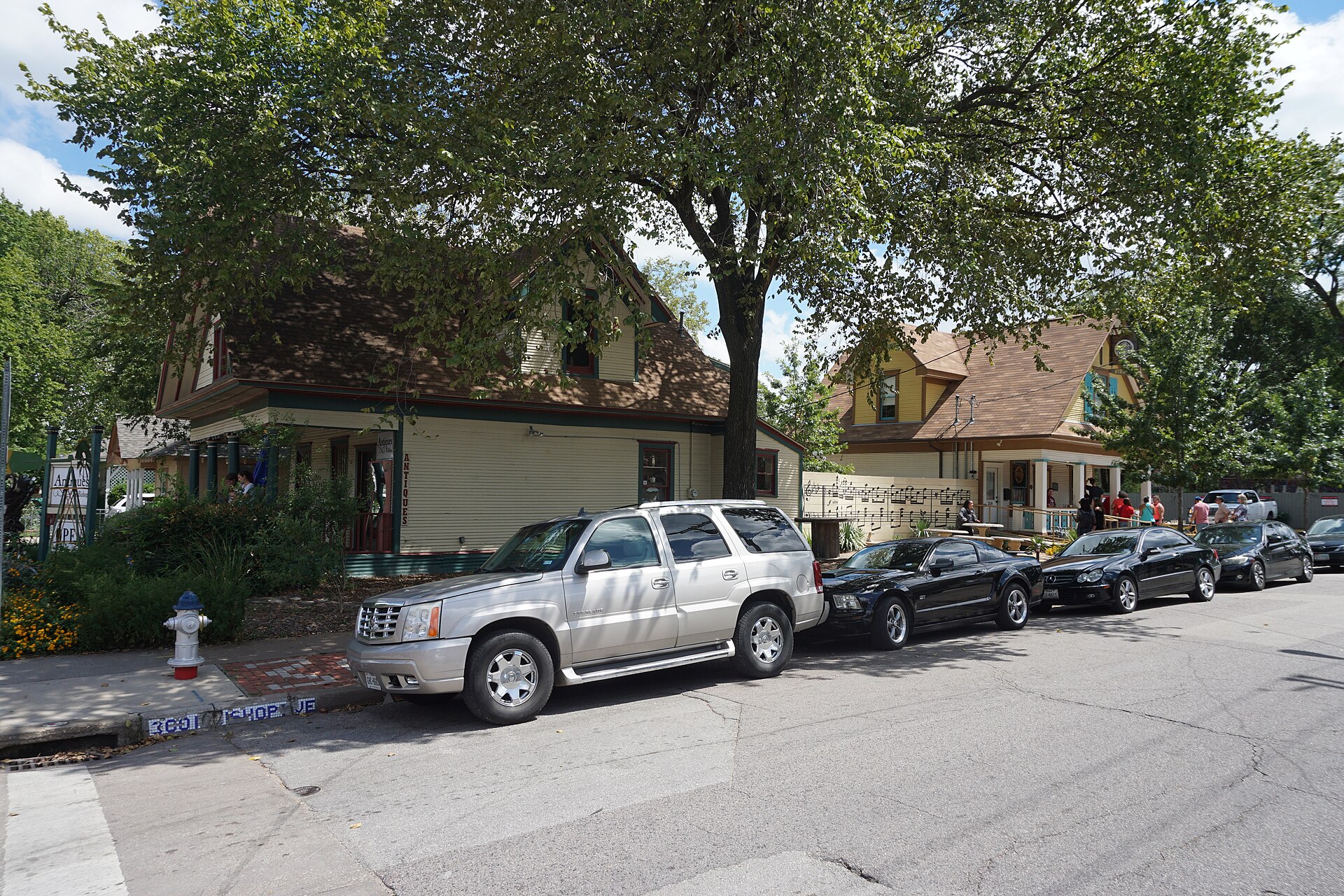
A trolley stop that became Dallas's favorite main street: 1920s storefronts in Oak Cliff packed with independent shops and restaurants, bungalow streets behind them, and a streetcar back to Union Station in about 11 minutes.
The short version
Bishop Arts District
A trolley stop that became Dallas's favorite main street: 1920s storefronts in Oak Cliff packed with independent shops and restaurants, bungalow streets behind them, and a streetcar back to Union Station in about 11 minutes.
.jpg)
At a Glance
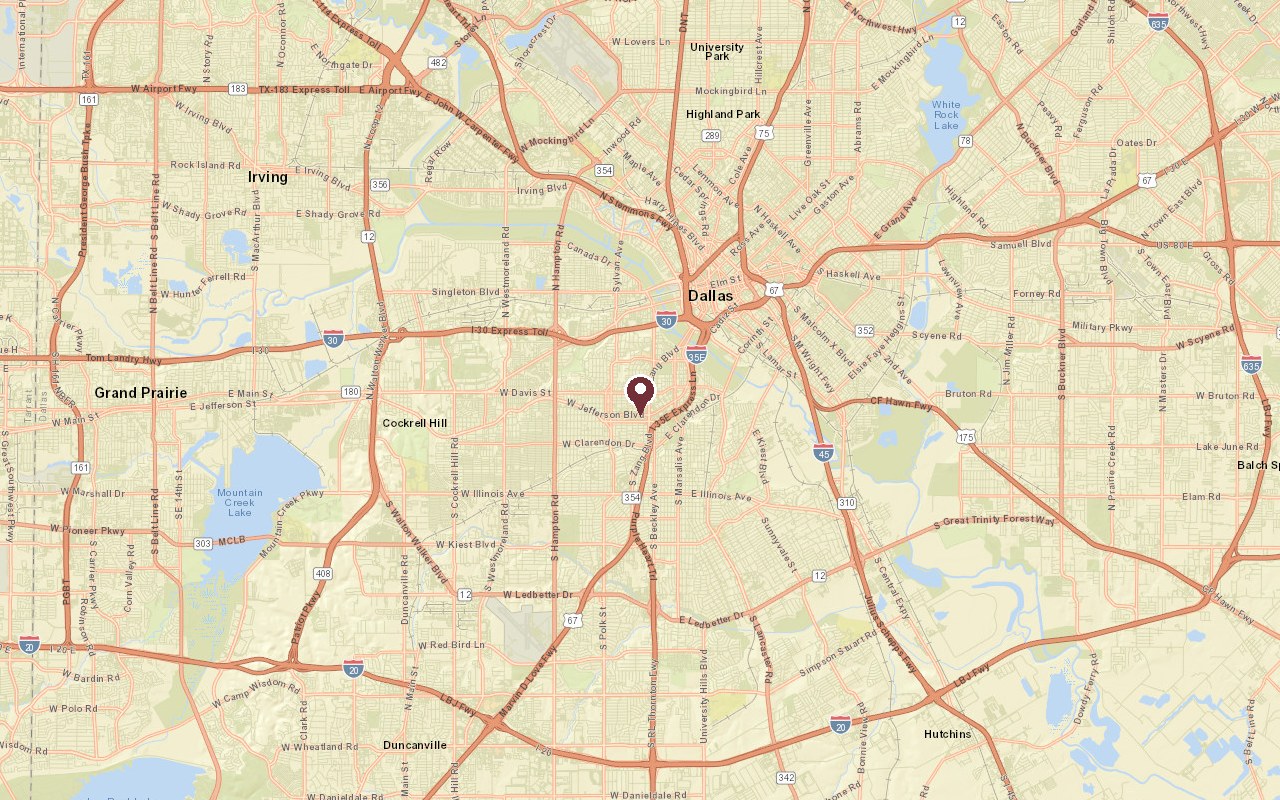
Second measure: Redfin puts the median sale price for the area around its Bishop Arts listings at $369,703 (Redfin, October 13, 2026).
A district with this much buzz pricing like a regular Dallas neighborhood is the whole story here.Texas cost notes. Texas has no state income tax, so property tax does the heavy lifting. The City of Dallas charges $0.6978 per $100 of valuation for FY2026-27, Dallas ISD $0.985735, and Dallas County $0.248650. Those three alone total about $1.93 per $100, roughly $7,900 a year at the neighborhood median before smaller levies and exemptions. The school homestead exemption takes $140,000 off a primary home's school taxable value, and a homestead's assessed value cannot rise more than 10 percent a year.
The Story
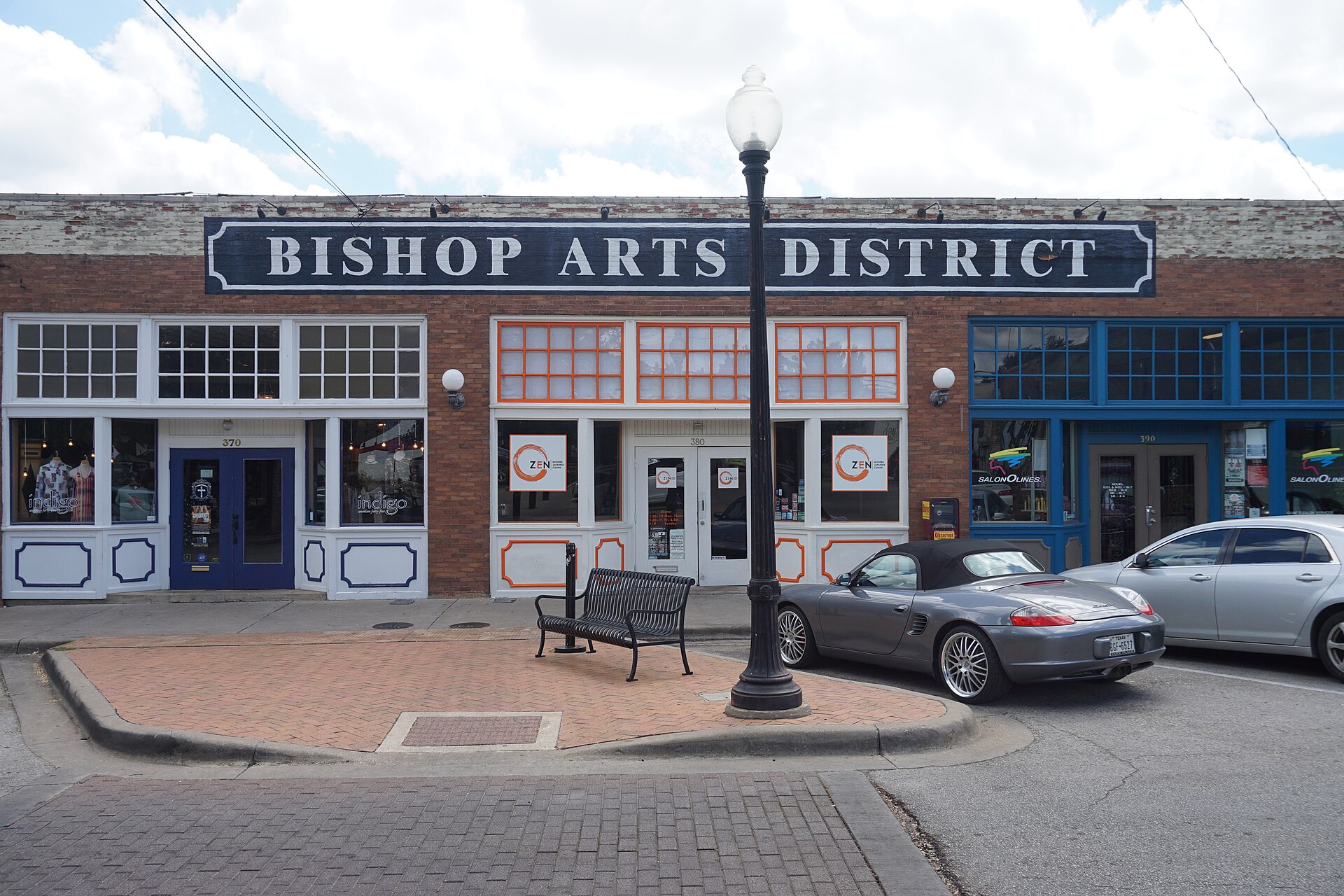
Bishop Arts exists because a trolley stopped here. In the 1920s, warehouses and shops clustered around the Oak Cliff streetcar stop where Bishop Avenue meets Davis Street, and by the 1930s the Davis Street stop was the busiest in Dallas. The storefronts that line Bishop Avenue today are largely the buildings that trolley built: small, one and two story commercial blocks made for people arriving on foot.
See moreSee less
When the streetcars stopped running and the malls rose after the war, the district emptied out. Through the 1960s and 1970s Oak Cliff lost its middle class, and by the early 1980s the old system's busiest corner was a row of worn storefronts with more vacancies than tenants. The turnaround came one buyer at a time. In the mid-1980s, developer Jim Lake Sr. and his partner Mike Morgan started buying the old buildings one at a time. Artists had been storing canvases in some of the empty storefronts, which is how the stretch picked up the name Bishop Arts. One of Lake's first moves was landing a Dallas police substation inside one of the buildings, a safety anchor for the blocks around it.
The rebuild ran on patience. Renovations stretched through the 1990s and 2000s; in the early 2000s the city rebuilt the streetscapes with trees and brick sidewalks. A zoning change mattered as much: parking requirements for restaurants and retail were cut in half, so a new business no longer meant tearing down an old building for parking. Part of the district is now on the National Register of Historic Places as the North Bishop Avenue Commercial Historic District.
The circle closed in 2016, when the Dallas Streetcar extension opened on August 29 and made Bishop Arts the southern terminus of the line, with service over the Houston Street Viaduct to Union Station. A neighborhood that a trolley built, that cars nearly killed, and that one stubborn buyer rebuilt storefront by storefront now has its streetcar back. Half a mile east on Jefferson Boulevard, the Texas Theatre still runs movies under the marquee where Lee Harvey Oswald was apprehended in 1963.
.jpg)
Timeline
- 1920s: Shops and warehouses cluster around the Oak Cliff trolley stop at Bishop Avenue and Davis Street.
- 1930s: The Davis Street trolley stop is the busiest in Dallas.
- November 22, 1963: Lee Harvey Oswald is apprehended at the Texas Theatre on Jefferson Boulevard, half a mile east.
- Mid-1960s to early 1980s: Streetcars gone and malls rising, the district empties out.
- Mid-1980s: Jim Lake Sr. and Mike Morgan begin buying Bishop Avenue storefronts; a police substation anchors one building.
- Early 2000s: The city rebuilds the streetscapes, and parking rules ease so old buildings can stay.
- August 29, 2016: The Dallas Streetcar extension opens, making Bishop Arts the line's southern terminus.
What It Actually Feels Like
Bishop Avenue on a Saturday is shoulder to shoulder: brunch lines, a wine walk crowd by afternoon. Two blocks in any direction, the neighborhood exhales into porch streets where the loudest thing is a lawn crew. Residents learn the rhythm fast: mornings and weekdays for errands, evenings after the day crowds go home. Summer heat is the real governor; the walkable life runs early and late from June through September.
.jpg)
Pros and Cons
Pros
- A genuine main street: more than 60 independent businesses in two blocks, almost no chains.
- Dallas prices: a neighborhood median of $410,000 (Homes.com, October 2026), with active listings under $300,000.
- The streetcar reaches Union Station in about 11 minutes for a $1 fare (DART).
- Historic fabric with legal protection; the streetscape that draws people cannot be casually demolished.
- Kidd Springs Park and Lake Cliff Park add green space most inner neighborhoods lack.
Cons
- Weekend crowds and scarce parking on the commercial blocks; residents on side streets feel both.
- The streetcar runs every 20 minutes and stops at midnight, so it supplements a car rather than replacing one.
- Homes sit on the market: Redfin reports area homes take about 47 days to go pending, and 26% took a price drop in the past month (October 13, 2026).
- Dallas property taxes are steep, and older homes carry older-home maintenance.
- Summer heat caps the walkable lifestyle for a third of the year.
Housing in Detail
Entry: original cottages and small homes on the side streets, roughly $275,000 to $400,000; today's $299,999 listing, a 1936 four-bedroom with 2,001 square feet, is the shape of it. Mid: renovated bungalows and newer infill, roughly $450,000 to $750,000, including the Bishop Heights streets by Kidd Springs Park. Top: the character stock and the big renovations, $800,000 and up, where a preserved 1945 duplex at $835,000 anchors the top. Renting runs cheaper than the reputation: the average one-bedroom apartment is $1,667 a month (Apartments.com, July 2026), .
Daily Life
Coffee and breakfast on Bishop, galleries and vintage shops through the day, and dinner patios that fill by seven. The Kessler Theater, a 1940s movie house turned music venue, anchors nights a few blocks west, and the Texas Theatre runs films on Jefferson. Groceries sit close: a Fiesta Mart on Jefferson and full supermarkets a short drive down Davis. Kidd Springs Park is the neighborhood's backyard.
Best For / Think Twice If
Best for: buyers who want a walkable main street at a Dallas price; food lovers who will use the restaurants and shops; downtown workers who want a streetcar commute and a porch.
Think twice if: you need quiet streets on weekends; you want to give up a car entirely; you are counting on a quick resale.
Top Properties Right Now
$299,999
314 W Clarendon Dr, Dallas, TX 75208
4 beds, 2 baths, 2,001 sq ft. Built 1936.
The entry point: a one-story 1936 house on the Clarendon Drive side of the district, priced under $300,000 and under $150 a square foot.
Listing verified on Redfin, October 13, 2026. View on Redfin
$694,999
629 Bishop Heights Ln, Dallas, TX 75208
4 beds, 3.5 baths, 2,638 sq ft. Built 2016.
A newer Craftsman style build in the Bishop Heights pocket next to Kidd Springs Park, a short walk from the Bishop Avenue shops. HOA dues run $150 a month.
Listing verified on Redfin, October 13, 2026. View on Redfin
$835,000
413 W 9th St, Dallas, TX 75208
4 beds, 3 baths, 2,960 sq ft. Built 1945.
A preserved 1945 duplex, both units, steps from Bishop Avenue: live in one side and rent the other, in the middle of the historic blocks.
Listing verified on Redfin, October 13, 2026. View on Redfin
Nearby Alternatives
- Kessler Park: the grand old Oak Cliff streets just west, bigger homes on winding, wooded lots at higher prices.
- Winnetka Heights: one of Dallas's largest historic districts, prairie style and craftsman homes on quiet streets.
- The Jefferson Boulevard corridor: rougher edges and lower prices east of the district, the next stretch of the same revival story.
Sources
Data as of the dates shown above. Refresh due within 90 days for listings and 6 months for market data.
- Homes.com, Bishop Arts District neighborhood page, median sale price and year change, October 2026: homes.com
- Redfin, 314 W Clarendon Dr listing page (area median sale price $369,703; area homes go pending in about 47 days; 26% of area homes with a price drop in the past month), October 13, 2026: redfin.com listing page
- Apartments.com, Bishop Arts District local guide, average one-bedroom apartment rent, July 2026: apartments.com
- Walk Score neighborhood scores for Bishop Arts District (Walk 91, Transit 52, Bike 62), via ApartmentHomeLiving: apartmenthomeliving.com
- DART, Dallas Streetcar schedule (Bishop Arts Station to Union Station, about 11 minutes): dart.org schedule
- DART, news release: Bishop Arts extension opens August 29, 2016: dart.org
- D Magazine, Bishop Arts and Southern Dallas development (Jim Lake, police substation, streetscape and parking reforms), 2018: dmagazine.com
- D Magazine (D CEO), Jim Lake Jr. and North Texas redevelopment (mid-1980s storefront purchases, the Bishop Arts name), 2017: dmagazine.com
- City of Dallas, FY2026-27 adopted tax rate ($0.6978 per $100); Dallas ISD, adopted tax rate ($0.985735 per $100), August 2026; Dallas County, adopted tax rate ($0.248650 per $100), 2026.
- Redfin, 629 Bishop Heights Ln listing, MLS NTREIS #21401857, October 13, 2026: redfin.com listing page
- Redfin, 413 W 9th St listing, MLS NTREIS #21384211, October 13, 2026: redfin.com listing page
- Michael Barera, Bishop Avenue in the Bishop Arts District (hero photograph), September 2016, Wikimedia Commons, CC BY-SA 4.0: commons.wikimedia.org
- Michael Barera, Bishop Arts District storefronts (story photograph), September 2016, Wikimedia Commons, CC BY-SA 4.0: commons.wikimedia.org
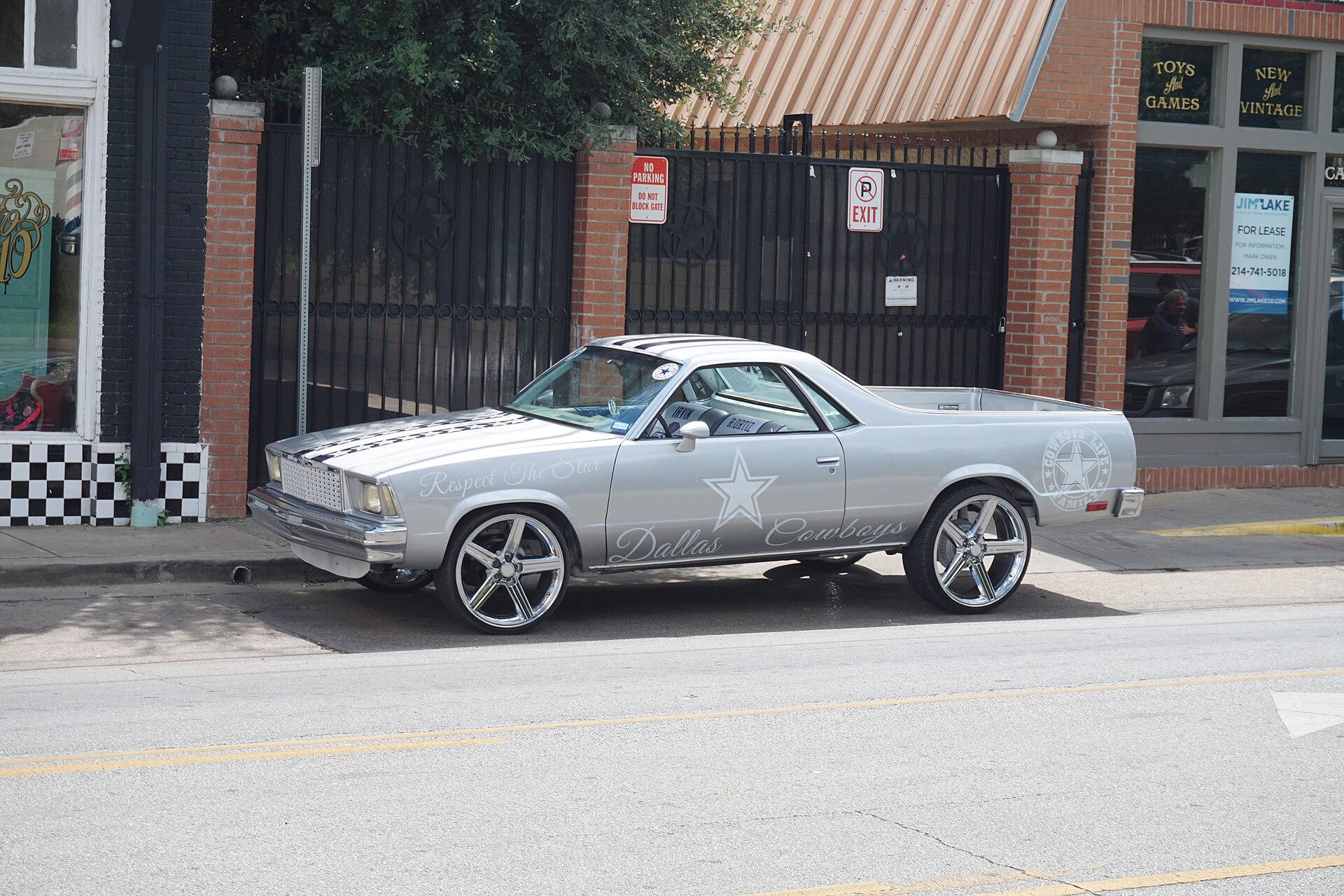
- Michael Barera, Dallas Cowboys Chevrolet El Camino in the Bishop Arts District (photograph), September 2016, Wikimedia Commons, CC BY-SA 4.0: commons.wikimedia.org